Beginner’s Guide to Personal Finance in the Philippines
Your journey to financial freedom starts here.
Personal Finance is managing your income & expenses, saving, investing, and planning your finances. This is important because or rising inflation, low average wages, and unstable job markets. To start, you need to track your income & expenses, build an emergency fund, clear debt, and invest wisely.
You work hard and pay your bills on time. And you already know you’re the “go-to” person when a relative needs help. But every month ends the same way: waiting for the next paycheck to restart the cycle.
This is common for many Filipinos. And lately, we’ve been saving more.
In fact, the Philippine Statistics Authority (PSA) reported that national gross savings climbed by 16.7% in 2024, reaching nearly ₱7.7 trillion.
But here’s the problem: saving alone isn’t enough.
We can save more and still fail to protect or grow our money.

Recent data from the Insurance Commission shows that insurance penetration is still around 1.78% in 2025. That gap matters because one major hospital bill can wipe out years of savings.
The World Bank reports that only about half of Filipino adults have a formal financial account, which means a lot of money sits idle instead of earning interest.
If you feel stuck, it’s not because you lack discipline. It’s usually because you lack a system.
This guide is the system. We’ll simplify personal finance and rebuild it for the Philippine setting.
Whether you earn ₱20,000 or ₱200,000, this guide covers four pillars: Cash Flow, Protection, Debt, and Investing.
Stop guessing. Let’s build a plan you can follow starting today.
Whether you’re a working professional or a small business owner, this guide shows you why personal finance matters, how it works, and how to apply it realistically in the Philippines even if your income isn’t 6 digits yet.
No hype. No jargon. Just practical steps you can apply this week.
Jump to:

Cash Flow and Budgeting
The Foundation
You can’t invest what never stays in your account.
Before we talk about stocks, mutual funds, or buying property, we must fix the foundation: Cash Flow. In simple terms: money in vs. money out.
Many Filipinos think it’s an income problem (“If only I earned ₱50k…”). Often, it’s an allocation problem: the money leaves as fast as it arrives.
If you cannot manage ₱20,000, you will not be able to manage ₱200,000. Lifestyle inflation will quietly expand to match your income.
Step 1: Stop guessing and track everything
You can’t improve what you don’t measure. For the next 30 days, track every peso. Yes, even that ₱150 milk tea or the ₱50 parking fee.
- Tool: Use a notebook, a Google Sheet/Excel file, or a mobile app.
- Resource: Check out our list of the best personal finance apps for Filipinos to automate this process.
Step 2: Use the 50/30/20 rule
One simple framework is the 50/30/20 rule.
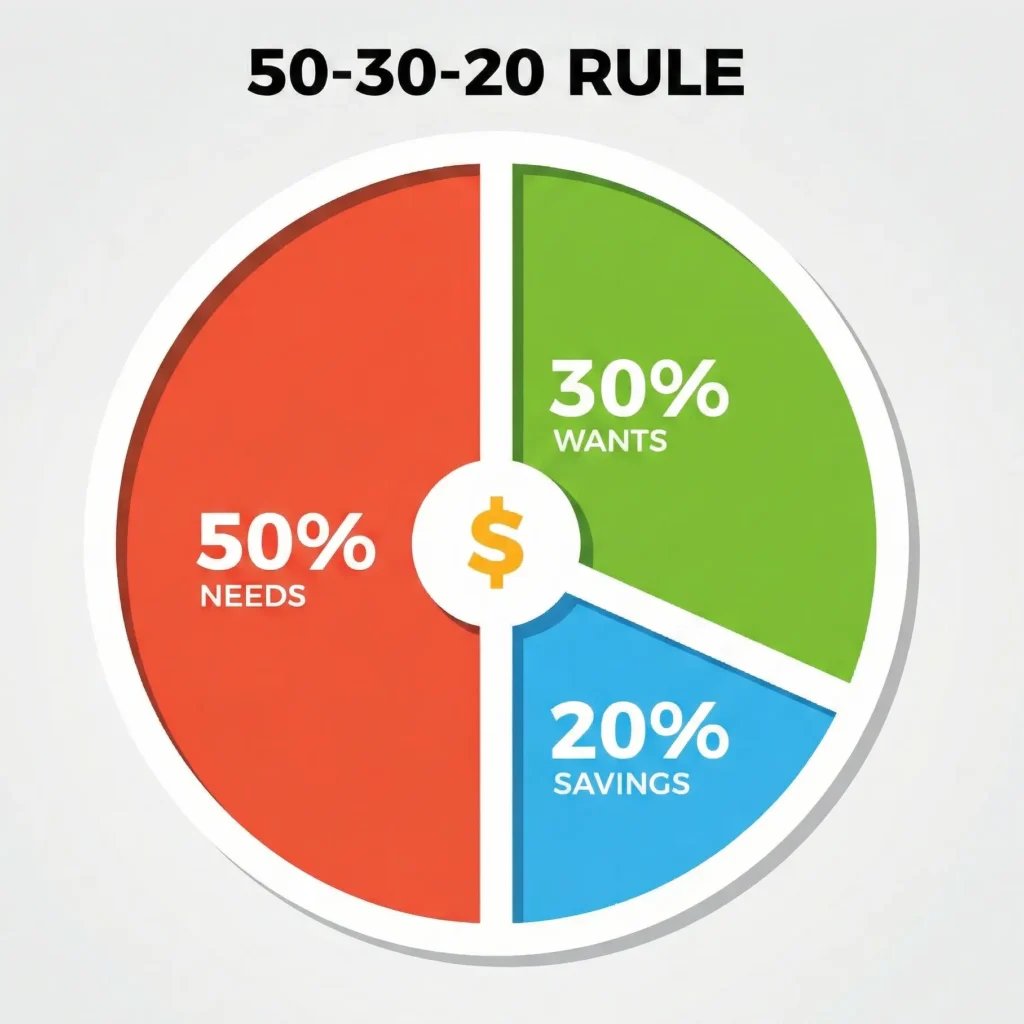
- 50% Needs: rent, Meralco, water, groceries, internet (essential for work), commute
- 30% Wants: dining out, Netflix, travel, Shopee/Lazada, hobbies
- 20% Savings: emergency fund, investments, insurance
Reality check: If you live in Manila, pay rent, and earn entry-level wages, 50% for needs may be unrealistic. Inflation in the Philippines makes this hard.
If 50/30/20 doesn’t fit, use 70/20/10 for now:
- 70% Needs: cover your survival basics first
- 20% Wants: cut down on the “nice to haves”
- 10% Savings: This is the non-negotiable part. Even if it’s just ₱500 a month, the habit matters more than the amount.
Step 3: Manage the “Black Tax” (family support)
This is unique to our culture. Many of us are part of the “Sandwich Generation” supporting aging parents while trying to raise our own children or save for ourselves.
Here’s where “padala” or “abot” fits in your budget.
- Ideally: It should come from your 30% Wants. You are choosing to help, which is a noble want, but it shouldn’t sacrifice your survival.
- Realistically: If it’s mandatory (e.g., paying for your sibling’s tuition), treat it as a Need (Expense). But you must set boundaries. If you burn your own budget, you eventually can’t help anyone.
Quick fix: If credit cards or online shopping trigger overspending, use cash (or debit) for wants for 30 days.

Emergency Funds and Banking
The Safety Net
Investing without a safety net is how people end up borrowing at the worst time. Before you invest a single peso in the stock market, you need a safety net.
In the Philippines, life happens fast. A typhoon, a broken refrigerator, or a hospital bill can erase months (or years) of progress fast. Without a safety net, you will be forced to borrow money (often at high interest rates) just to survive.
Step 1: Build the Emergency Fund
An Emergency Fund (EF) is cash that you set aside strictly for unexpected disasters. It is not for a new iPhone, a seat sale to Japan, or “investment capital.” It protects your future income from emergencies.
The Golden Rule: Save 3 to 6 months of expenses. Notice I said expenses, not income.
- If you earn ₱30,000 but your survival expenses (needs) are only ₱15,000, your target EF is not ₱90k, it’s ₱45,000 to ₱90,000
- 3 Months: good for singles with stable jobs
- 6 Months: necessary for freelancers, breadwinners, or those with dependents
Step 2: Stop Losing Money (banking strategy)
Where do you keep your money? If your emergency fund sits in a traditional savings account (BDO, BPI, Metrobank), inflation can quietly reduce its buying power.
Why? Inflation. Inflation in the Philippines often lands in the 3% to 5% range over long periods. Most traditional banks pay an interest rate of 0.0625% per annum.
Do the math:
- Interest Earned: +0.06%
- Inflation Loss: -4.00%
- Real Return: -3.94%
Your money is literally shrinking in value.
The Solution? Digital banks!
The game changed when the Bangko Sentral ng Pilipinas (BSP) authorized Digital Banks. Digital banks (for example: Maya, SeaBank, GoTyme, CIMB, Netbank) often offer higher rates because they run leaner operations (rates can change and may depend on conditions).
|
Feature |
Traditional Banks |
Digital Banks |
|---|---|---|
|
Interest Rate |
around 0.0625% per annum |
around 2.5% to 6.0% per annum |
|
Minimum Balance |
Usually ₱2,000 – ₱10,000 |
usually ₱0 |
|
PDIC Insured? |
Yes (up to ₱500k) |
Yes (up to ₱500k) |
|
Best for… |
ATM withdrawals & Payroll |
Parking savings & Emergency Funds |
So here’s your new strategy:
Resource: Which digital bank has the best app and highest rates? Check our updated list of top digital banks in the Philippines.

Insurance and Protection
The Shield
You can save ₱1 million in five years, but you can lose it all in five days.
One critical illness can cost hundreds of thousands to millions in the Philippines, depending on the case and hospital. According to 2025 industry reports, medical inflation in the Philippines is projected to hit 18.3%, far outpacing the price of goods.
If you do not have protection, your “Emergency Fund” will be wiped out instantly, and you’ll end up paying for it with future income through loans.
Think in 3 layers, built in this order:
Layer 1: PhilHealth (The Government Shield)
Every Filipino employee has this, but few understand it.
- What it does: It pays for a specific “Case Rate” (a fixed amount) for your confinement.
- Reality: it usually works like a partial subsidy, not full coverage.
- Example: If you get Dengue, PhilHealth might cover ₱10,000. If your hospital bill is ₱50,000, you still owe ₱40,000.
- Action: Ensure your contributions are active. It is the mandatory first layer of payment in any hospital billing section.
Layer 2: HMO (The Frontline Shield)
This is your “Maxicare,” “Intellicare,” or “Medicard.”
- What it does: It covers outpatient checkups, emergency room fees, and minor confinements up to a limit (usually ₱150k to ₱200k per illness).
- The gap: Most corporate HMOs are strictly linked to your employment. If you resign or get fired, you lose your coverage instantly.
- Action: If you are a freelancer or your company doesn’t provide one, a prepaid health card is a practical baseline while you build fuller coverage.
Layer 3: Medical & Life Insurance (The Catastrophic Shield)
This is for the “Big Ones”. I’m talking about cancer, heart attack, stroke, or death.
- Life Insurance: Replaces your income if you die. If you have no dependents (spouse/kids), you might not need this yet. Resource: check out the best life insurance companies in the Philippines
- Health Insurance: Gives you a lump sum of cash (e.g., ₱1 million) if you are diagnosed with a critical illness. You use this money to pay for chemo, dialysis, or surgery that your HMO cannot cover. Resource: Best health insurance providers in the Philippines
The Great Debate: VUL vs. Term Insurance
Chances are you’ll be offered a VUL (Variable Universal Life) plan at some point. It bundles insurance with an investment component.
- The Pitch: “Pay this for 10 years, and you’re insured for life plus you have savings!”
- The Reality: VULs have high management fees. If the market performs poorly (as the PSEi did from 2016-2024), your “investment” value might drop, forcing you to pay more to keep the policy alive.
BTID (Buy Term, Invest the Difference) – The Alternative Strategy
- Buy term insurance: Buy a “Term Insurance” policy. It is pure protection with no investment and no cash back. It is much cheaper (e.g., ₱12k/year for ₱3M coverage).
- Invest the difference: Take the money you saved (vs. buying a VUL) and put it into MP2 or a Digital Bank yourself.
- Verdict: BTID often costs less over time if you consistently invest the difference. If you’re a spender, a VUL might be a “forced savings” mechanism that works better for your behavior.

Debt Management
The Chains
Debt slows your progress because it eats future cash flow. That debt is called bad debt.
Debt is common in the Philippines, but not all debt is equal.
- Wealthy people use debt to buy assets.
- Struggling people often use debt to buy lifestyle.
The difference lies in how you use it.
Good Debt vs. Bad Debt
- Good debt puts money in your pocket
- Examples: A housing loan (mortgage) for a rental property, a business loan to expand your inventory, or a laptop loan if you use that laptop to do freelance work.
- Bad debt takes money out of your pocket and buys things that lose value
- Examples: Credit card interest (3% per month is 36% per year!), car loans for a luxury vehicle you can’t afford, and “Buy Now Pay Later” (SPayLater/LazPayLater) for clothes or gadgets.
The “5-6” Trap: Never, under any circumstances, borrow from informal “5-6” lenders. The interest rates are mathematically impossible to outrun. If you’re already struggling, 5-6 makes the math worse, fast.
Two Strategies to Attack Your Debt
If you have multiple debts, you need a battle plan. There are two proven methods to clear them.
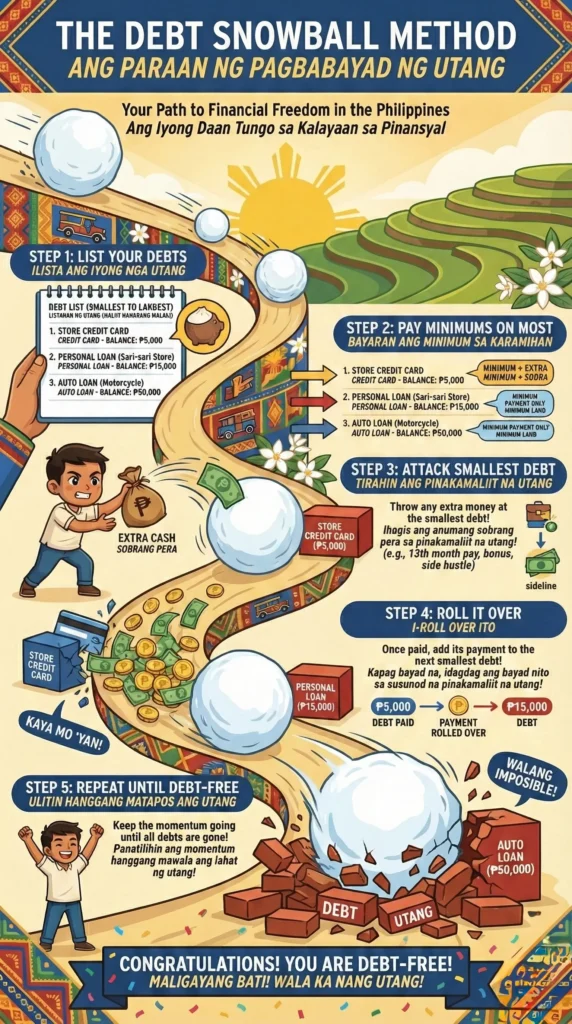
Strategy A: The Debt Snowball (best for motivation)
- How it works: list your debts from smallest balance to largest balance. Ignore the interest rates for now.
- The move: pay the minimum on everything, but throw all your extra cash at the smallest debt.
- The result: you wipe out the small debt quickly. This psychological “win” gives you the momentum to attack the next one. This works best if you feel overwhelmed.
Strategy B: The Debt Avalanche (best for Math)
- How it works: list your debts from highest interest rate to lowest interest rate.
- The move: attack the debt with the highest interest (usually credit cards) first.
- The result: you save the most money on interest payments in the long run, but it might take longer to see the first debt disappear completely.
IDRP – A practical option if you’re stuck
If your credit card debt is so massive that you cannot pay even the minimums, do not hide. Contact your bank immediately and ask about the Interbank Debt Relief Program (IDRP) or a Balance Restructuring Agreement.
- What it does: Banks may agree to freeze your interest and allow you to pay off the principal over 3-5 years at a manageable rate. They would rather get some money back than zero.
Resource: Feeling hopeless about your bills? Read our comprehensive guide on how to get out of debt fast.

Investing
Growing Wealth
Saving protects you. Investing helps your money grow.
If you keep all your money in a savings account earning 0.1%, and inflation is 4%, you are becoming 3.9% poorer every year. The goal of investing is simple: Beat Inflation.
You do not need to be a math genius or a day trader to build wealth. You just need to pick the vehicle that matches your “Risk Appetite” (how much volatility you can tolerate without panic-selling).
Level 1: Pag-IBIG MP2 (Modified Pag-IBIG II)
Low-effort, low-risk option
This is arguably the best investment for conservative Filipinos.
- What it is: A voluntary savings program by the government.
- The return: Historically earns 6% to 8% per annum (tax-free dividends).
- The catch: Your money is locked for 5 years.
- Why it wins: It is government-guaranteed. You cannot lose your principal.
Level 2: Mutual Funds and UITF
The “Hands-off” Investor (Medium Risk)
- What it is: You pool your money with other investors, and a professional Fund Manager invests it for you.
- Equity funds: They buy stocks (Jollibee, SM, Ayala). High growth potential, but can drop in value.
- Money market funds: They buy safe, short-term debt. Lower risk, lower return.
Level 3: Philippine Stocks, REITS and Global Feeder Funds
The “Active” Investor (High Risk)
- Philippine Stock Exchange (PSE): buying individual stocks (like buying shares of Jollibee or PLDT directly).
- The potential: you can earn dividends + capital appreciation.
- The risk: you can lose 50% of your money if you pick the wrong company. Requires study and emotional control.
- Global Feeder Funds: investing in US Tech stocks (Apple, Microsoft, NVIDIA) via local apps like GCash/GInvest or banks.
- “Double your money” in a few months
- “Guaranteed returns” of 10% or more per month
- A business with no product, just recruiting…
Run away if you encounter these offers. Legitimate investments (even the best ones) rarely earn more than 10-12% per year consistently. If it sounds too good to be true, it is.

Conclusion
Start small, start now
Building wealth usually looks boring: spend less than you earn, protect yourself, and invest consistently.
You now have the plan:
Don’t let “analysis paralysis” stop you. You don’t need ₱1 million to start.
You can start today with ₱500 by opening a digital bank account or beginning your MP2 contributions.
Pick one article from the list below and take your first step.